

Cost of Compliance
Compliance raises costs but ignoring it is far more expensive. It can improve security, yet alone it is not enough. Is it a burden or a strategic investment?

Are Regulations a Net Benefit or a Burden?
In the U.S., healthcare regulations like HIPAA are often blamed for rising costs. Hospitals poured billions into privacy systems, staff training, and audits. And yet, breaches still happen. Was all that spending worth it?
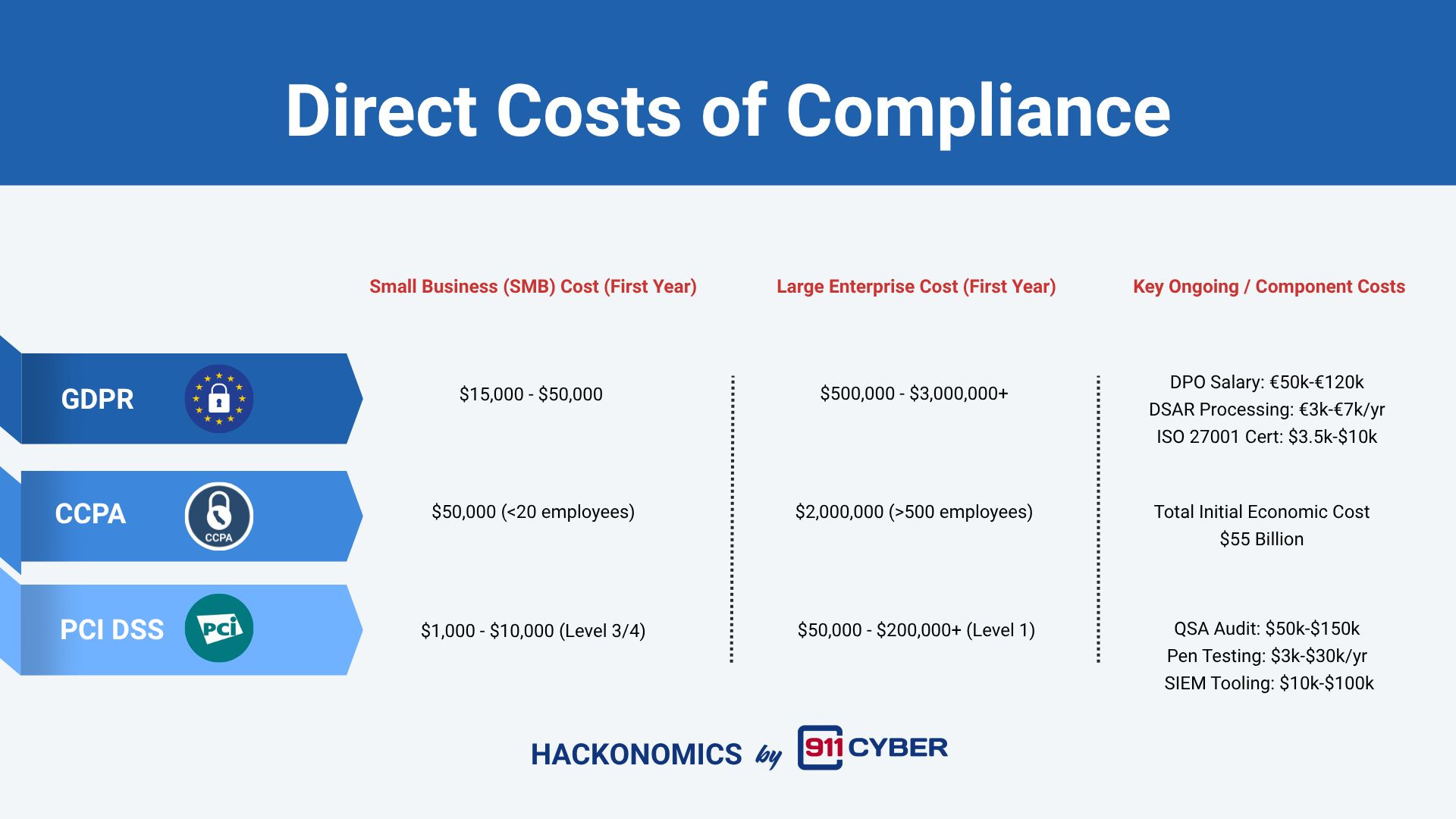
Cybersecurity is facing the same question. GDPR, CCPA, PCI DSS, and emerging AI rules force companies to dedicate teams, tools, and processes just to prove compliance. Small businesses may spend thousands a month. Large enterprises may spend millions a year.
So the question is simple. Does compliance actually make us safer, or does it just drive up costs?
1️⃣ Compliant but still at risk
HIPAA costs about $8.3 billion a year. That is more than 70 times the original projection. And yet healthcare data breaches still cost an average of $10.9 million per incident.
Being compliant doesn’t automatically mean you are secure. Target, Heartland, and others were fully PCI-compliant when they got hit. Too often, companies treat compliance like a box to check instead of a real security strategy.
2️⃣ Compliance can pay off
Non-compliance is often far more expensive than compliance. Studies show that the cost of ignoring rules can be 2.7 times higher than the cost of following them. On average, compliance costs $5.5 million. Non-compliance? Almost $15 million per incident.
Compliance can also improve security. Companies with tested incident response plans save about $1.5 million per breach. Breaches in non-compliant organizations cost an extra $174,000 on average.
3️⃣ Where compliance becomes a burden
For large enterprises, the problem is complexity. Overlapping rules force teams to spend more time translating controls than actually stopping threats. For small businesses, the problem is absolute cost. CCPA compliance can cost a 20-person company $2,500 per employee. For a 5,000-person company, it’s $400 per employee. That can be a real barrier to entry.
4️⃣ The big takeaway
The question is not “cost versus benefit.” It’s “cost versus consequence.” Compliance is not the enemy. Done right, it builds trust, reduces risk, and can even open doors to new markets.
So I want to hear from you.
👉 Do you see compliance as a cost center, or a strategic investment in resilience?
Interested in the economics behind cybersecurity?