

🧠 Humans of Cyber | Cyril Jaquier
Fail2ban (2004–2026) blocks brute-force attacks by monitoring logs and dynamically banning abusive IPs across servers and clouds.

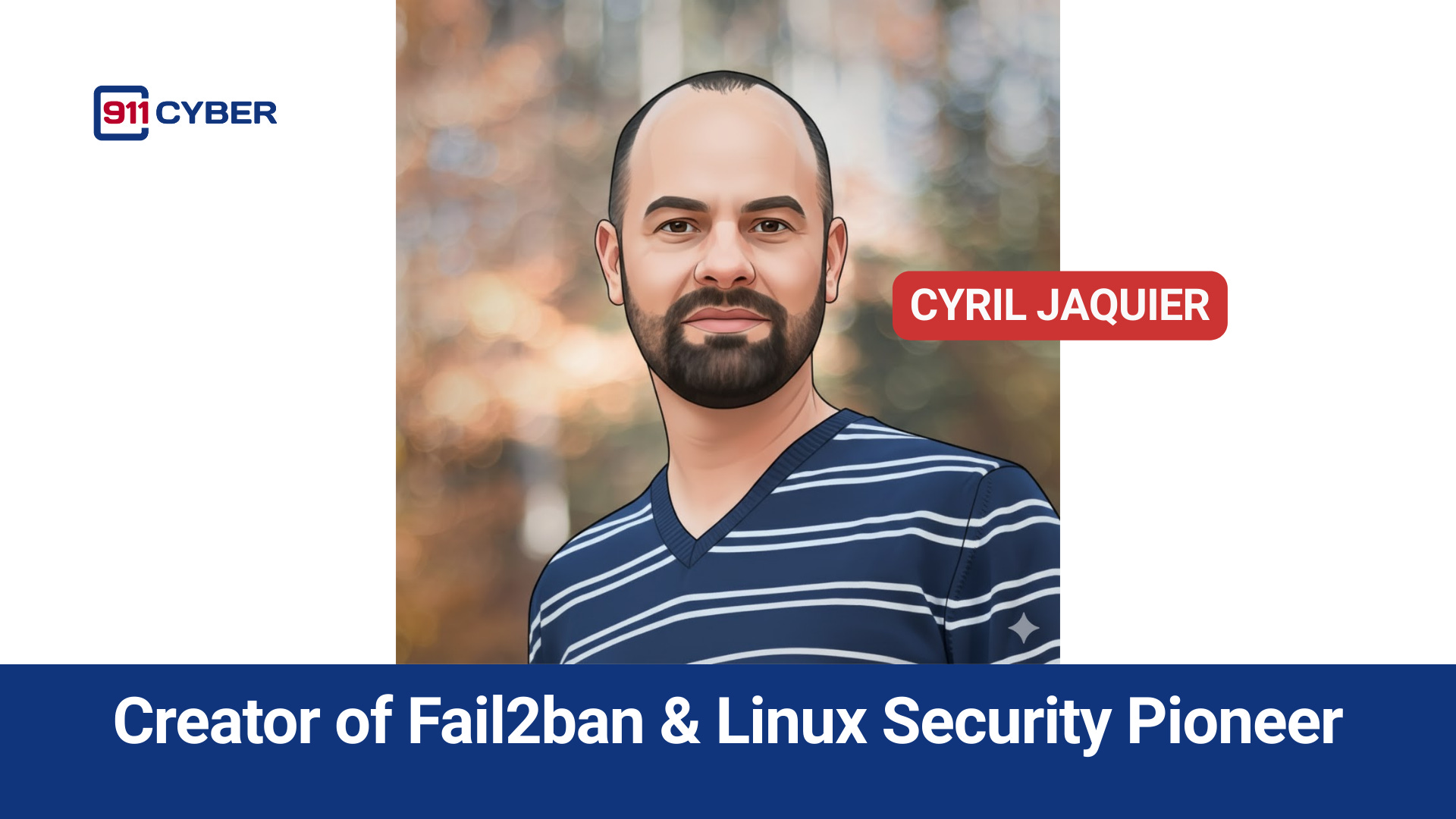
Modern server security often emphasizes complex layered architectures, yet some of the most effective controls operate quietly at the operating system level. Fail2ban is one such control. Written in Python and released in 2004, Fail2ban provides reactive intrusion prevention by analyzing authentication and service logs in real time and dynamically blocking abusive IP addresses.
Its primary objective is narrow but critical: mitigate brute-force attacks and credential abuse against exposed services such as SSH, FTP, mail servers, and web applications. By reacting to observed behavior rather than relying solely on static firewall rules, Fail2ban has remained relevant through transitions from physical servers to virtual machines and cloud-native workloads.
Origins and Vision
Fail2ban was created on October 7, 2004 by Cyril Jaquier in response to the rapid growth of automated scanning and brute-force tools targeting internet-facing services. Traditional firewall frameworks such as Netfilter and iptables were effective at filtering traffic by port or IP address, but they lacked behavioral awareness. They could not distinguish between legitimate authentication attempts and automated password guessing.
Jaquier’s innovation was to treat system logs as a telemetry source for intrusion prevention. Instead of blocking traffic preemptively, Fail2ban monitors log files for repeated failed authentication attempts and then enforces temporary network bans against the offending IP address. This approach integrates detection and enforcement without requiring a separate intrusion detection system.
Over the years, the project evolved through multiple milestones. Early versions focused primarily on SSH and iptables integration. Later releases introduced IPv6 support, database persistence, systemd journal compatibility, and nftables integration. By version 1.1.0, released in 2024, the framework supported modern Python runtimes and contemporary Linux networking stacks.
Core Architecture: Jails and Filters
The fundamental unit of operation in Fail2ban is the jail. A jail combines a detection filter with an enforcement action. This modular design allows administrators to protect multiple services independently while using a consistent control framework.
Fail2ban operates as a daemon called fail2ban-server. It continuously monitors specified log files or journal streams. When log entries match defined patterns, the system increments a failure counter for the corresponding IP address. If the number of failures exceeds a defined threshold within a configured time window, the IP address is banned for a specified duration.
Filters and Regular Expressions
Filters are implemented using Python regular expressions. Each filter contains failregex patterns designed to match service-specific failure messages. For example, an SSH filter must account for variations such as invalid user attempts, authentication failures, and connection closures during login.
The placeholder <HOST> inside the regex is a specialized capture group that extracts the attacker’s IP address from the log line. Accuracy in regex design is essential to avoid false positives and ensure correct IP identification.
As service log formats evolve, filters must be updated accordingly. For instance, changes in OpenSSH logging conventions required adjustments to Fail2ban’s SSH filter to maintain detection accuracy.
Enforcement and Firewall Integration
Once a threshold is exceeded, Fail2ban executes a configured action. In most deployments, this action inserts a blocking rule into the system firewall. Supported backends include:
iptables
nftables
firewalld
UFW
PF on BSD systems
In addition to firewall rule insertion, actions may include administrative notifications, execution of custom scripts, or integration with external threat intelligence services.
The separation between detection and enforcement allows administrators to tailor response strategies without modifying filter logic.
Persistence and State Management
A major architectural enhancement was the integration of an SQLite database to store ban history and failure records. The database, typically located at /var/lib/fail2ban/fail2ban.sqlite3, enables persistence across service restarts and system reboots.
Prior to database integration, active bans were stored only in memory or in firewall state. A restart could unintentionally clear active bans. The persistent database ensures continuity and allows the system to reapply bans on startup.
This persistence layer also enables behavioral escalation mechanisms such as incremental ban durations.
Incremental Bans and Recidivism Control
Fail2ban supports escalating penalties for repeat offenders. If an IP address returns after a ban expires and triggers new violations, the bantime can be increased according to configurable rules.
This behavior is conceptually represented by exponential backoff. Each subsequent violation results in a longer ban duration, increasing the operational cost for persistent attackers.
The recidive jail extends this concept. Instead of monitoring service logs directly, it monitors Fail2ban’s own log file. If an IP address has been banned repeatedly across multiple jails, the recidive jail can impose a significantly longer ban. This meta-layer provides protection against persistent distributed attackers who attempt repeated low-volume attacks.
Deployment in Cloud Environments
In cloud environments such as Amazon Web Services, Google Cloud Platform, and Microsoft Azure, Fail2ban continues to provide value despite the presence of native security groups.
Cloud security groups operate at the network boundary, while Fail2ban operates at the host level. This provides granular, instance-specific protection that remains effective even if perimeter rules are misconfigured.
Best practices in cloud deployments include configuring ignoreip to prevent accidental lockout of administrative access, particularly in environments using bastion hosts or dynamic IP ranges.
Fail2ban also integrates with centralized logging platforms, allowing administrators to maintain visibility across distributed infrastructure.
Distributed Defense and ZeroMQ Integration
Traditional Fail2ban deployments are host-local. This creates limitations when facing distributed brute-force attacks where multiple IPs each attempt minimal login attempts.
To address this, the community developed distributed synchronization mechanisms using ZeroMQ. ZeroMQ is a lightweight asynchronous messaging library that supports publish and subscribe communication patterns.
With fail2ban-zmq-tools, ban events can be broadcast across multiple servers. If an IP address is banned on one node, the event is propagated to peer nodes, creating a coordinated defensive perimeter across data centers or regions.
This collective defense model significantly increases the resilience of multi-node environments against distributed attack patterns.
Operational Management
Administrators interact with the system using the fail2ban-client utility. This tool allows real-time inspection of active jails, banned IPs, and failure counts without restarting the daemon.
The primary operational log is /var/log/fail2ban.log. Log levels can be adjusted to provide deeper visibility into regex matching, database interactions, and action execution.
Configuration best practice dictates using .local override files instead of editing default .conf files. This prevents configuration loss during package updates and ensures predictable override behavior.
Integration into Layered Security
Fail2ban is most effective when integrated into a layered security model. It complements:
SSH key-based authentication
Multi-factor authentication
Web application firewalls
Host intrusion detection systems
Application-layer logging controls
In WordPress environments, plugins such as WP-fail2ban forward authentication failures to syslog, enabling Fail2ban to enforce bans at the kernel firewall layer before application resources are consumed.
Limitations and Risk Considerations
False positives remain the most common operational risk. Misconfigured thresholds or shared NAT environments can result in legitimate users being temporarily banned.
Regex precision is critical to prevent incorrect IP extraction. Anchoring expressions and validating filter behavior in testing environments reduces this risk.
Spoofing concerns are mitigated by TCP handshake requirements for most service-based jails. Proper configuration of ignoreip entries further protects administrative access.
Fail2ban does not replace comprehensive intrusion detection systems or advanced behavioral analytics. Its strength lies in focused reactive enforcement against observable abuse patterns.
Conclusion
For over two decades, Fail2ban has remained a practical and resilient intrusion prevention framework. It has adapted from early Linux servers to modern cloud-native environments without sacrificing its core principle: observe malicious behavior in logs and react at the network level.
Its lightweight deployment model, modular architecture, database persistence, and optional distributed synchronization ensure continued relevance in 2026.
Fail2ban exemplifies a foundational cybersecurity principle. Effective defense does not always require complexity. It requires precise observation, measured response, and seamless integration into the existing operational environment.
Subscribe and Comment.
Copyright © 2026 911Cyber. All Rights Reserved.
Follow 911Cyber on: