

🧠 Humans of Cyber | Henning Brauer
Born from a 2001 licensing crisis, pf became OpenBSD’s stateful firewall, engineered for clarity, correctness, and high-speed resilience.

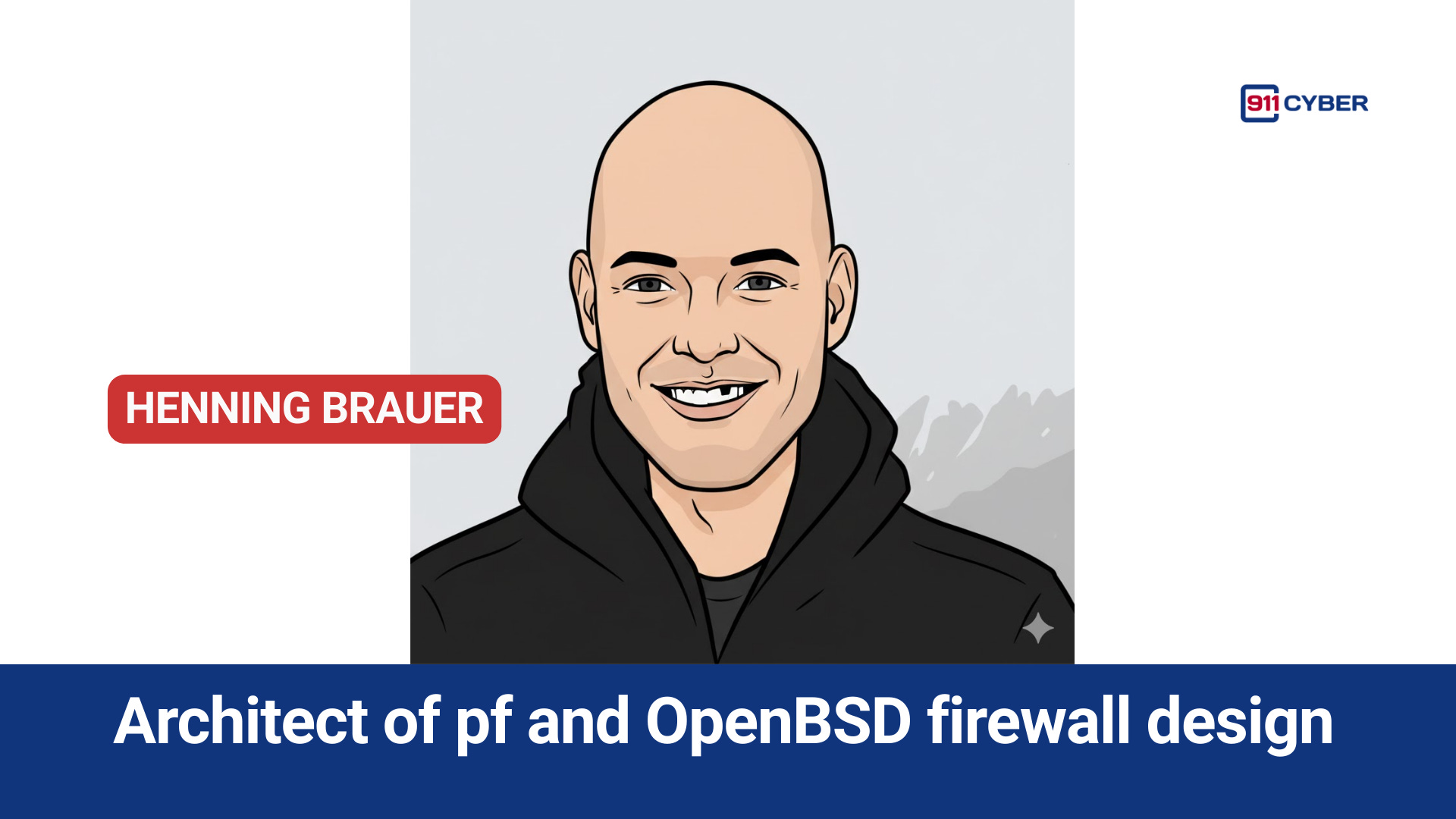
The packet filter known as pf occupies a distinctive position in the history of network security engineering. Developed within the OpenBSD project, pf represents a disciplined approach to firewall design that prioritizes transparency, auditability, and architectural correctness.
Its origin was not incremental innovation but structural necessity. In 2001, a licensing incompatibility involving IPFilter led to its removal from OpenBSD. Under the leadership of Theo de Raadt, the project initiated a rapid replacement effort. The first pf code was committed by Daniel Hartmeier on June 24, 2001. pf was officially released with OpenBSD 3.0 in December of that year.
Subsequent stewardship by Henning Brauer refined pf into a high-performance, production-grade stateful firewall capable of scaling to modern data center workloads.
Foundational Context: Licensing Crisis and Architectural Reset
On May 29, 2001, OpenBSD removed IPFilter from its source tree after identifying licensing terms that prohibited redistribution of modified code. This restriction conflicted with OpenBSD’s strict free-software requirements.
The removal created a firewall vacuum. Hartmeier initiated development of a new filtering engine designed from first principles. The objective was not only functional replacement but architectural improvement, with emphasis on clarity, deterministic behavior, and maintainability.
The release of pf marked a broader license audit across OpenBSD, reinforcing the project’s long-standing commitment to legal and technical integrity.
Design Philosophy: Declarative Clarity
pf’s configuration model reflects the OpenBSD philosophy of proactive security. Its rules resemble policy statements rather than procedural logic. The structure encourages a default-deny posture followed by explicit, human-readable exceptions.
Key characteristics include:
Last-match-wins rule evaluation
Optional quick keyword for immediate termination
Table support using radix trees for high-volume IP sets
Anchors for modular rule management
This declarative model enhances auditability. Administrators can reason about traffic policy without navigating nested chains or procedural constructs.
Stateful Inspection and Lifecycle Tracking
pf operates as a stateful packet filter by default. When a packet matches a pass rule, a state entry is created. Subsequent packets in the same connection bypass rule evaluation and are validated against the state table.
The state engine tracks:
TCP sequence numbers
Window scaling
Protocol attributes
Connection lifecycle timing
Stateful Tracking Options allow limits on connections per source, per rule, or globally. Optimization profiles such as aggressive and conservative adjust state expiration behavior based on traffic characteristics.
This approach provides resilience against spoofing and packet injection.
Traffic Normalization and Scrubbing
The scrub directive performs protocol normalization to eliminate ambiguities exploitable for evasion.
Capabilities include:
Fragment reassembly prior to filtering
Minimum TTL enforcement
TCP timestamp modulation
Maximum segment size enforcement
Randomization of IP identification fields
Fragment reassembly ensures the firewall evaluates complete packets rather than partial fragments. TCP normalization reduces opportunities for sequence prediction or TTL-based bypass techniques.
Normalization ensures that downstream systems observe traffic consistent with what the firewall evaluates.
Advanced Queueing and Bandwidth Control
Earlier versions of pf relied on ALTQ for traffic shaping. Performance limitations led to its replacement with an integrated queuing system centered on the Hierarchical Fair Service Curve scheduler.
HFSC enables:
Guaranteed minimum bandwidth for critical traffic
Strict maximum caps for low-priority flows
Hierarchical queue structures with borrowing capability
This architecture supports real-time traffic such as VoIP while preserving bulk throughput management.
Multi-Processor Scaling (2024–2026)
Historically constrained by coarse kernel locking, pf transitioned toward fine-grained locking and parallel processing between 2024 and 2025.
Improvements include:
Parallel UDP processing
Parallelized TCP stack with per-socket locking
Multi-queue NIC support with MSI-X interrupt balancing
Enhanced TCP Segmentation Offload support
These developments allow pf to leverage high-core-count systems and support 100 Gbit/sec traffic flows without abandoning its design principles.
Cross-Platform Divergence
pf has been ported to FreeBSD and forms the foundation of firewall platforms such as pfSense and OPNsense.
The FreeBSD implementation diverged to prioritize SMP scaling and features such as SCTP and VIMAGE virtualization. In 2024–2025, synchronization efforts reintroduced modern syntax improvements from OpenBSD.
Comparatively, Linux environments utilize nftables, which follows a programmable chain-based model. pf remains distinctive for its declarative rule structure and integrated logging via pflog.
Security Audit Discipline
OpenBSD maintains a rigorous file-by-file security audit culture. pf benefits from system-wide protections such as:
strlcpy and strlcat defensive string handling
W^X memory protection policies
Rapid full disclosure and patch cycles
Recent vulnerabilities have included race conditions and kernel crashes, each addressed promptly with publicly available patches.
The emphasis remains on eliminating entire vulnerability classes rather than reacting solely to demonstrated exploits.
Strategic Significance
pf demonstrates that performance scaling and architectural discipline are not mutually exclusive. Its evolution from a single-processor packet engine to a multi-core capable firewall underscores a commitment to incremental correctness rather than feature inflation.
Daniel Hartmeier’s foundational implementation and Henning Brauer’s long-term refinement established a model of firewall engineering grounded in transparency and predictability.
As of 2026, pf remains a reference architecture for stateful filtering in Unix-like systems. Its longevity reflects a consistent prioritization of clarity, stability, and defensible design within a rapidly changing network security environment.
Subscribe and Comment.
Copyright © 2026 911Cyber. All Rights Reserved.
Follow 911Cyber on: