

🧠 Humans of Cyber | Joe Beda, Brendan Burns, and Craig McLuckie
Open source container orchestration platform that automates deployment, scaling, and management of containerized applications across distributed clusters.

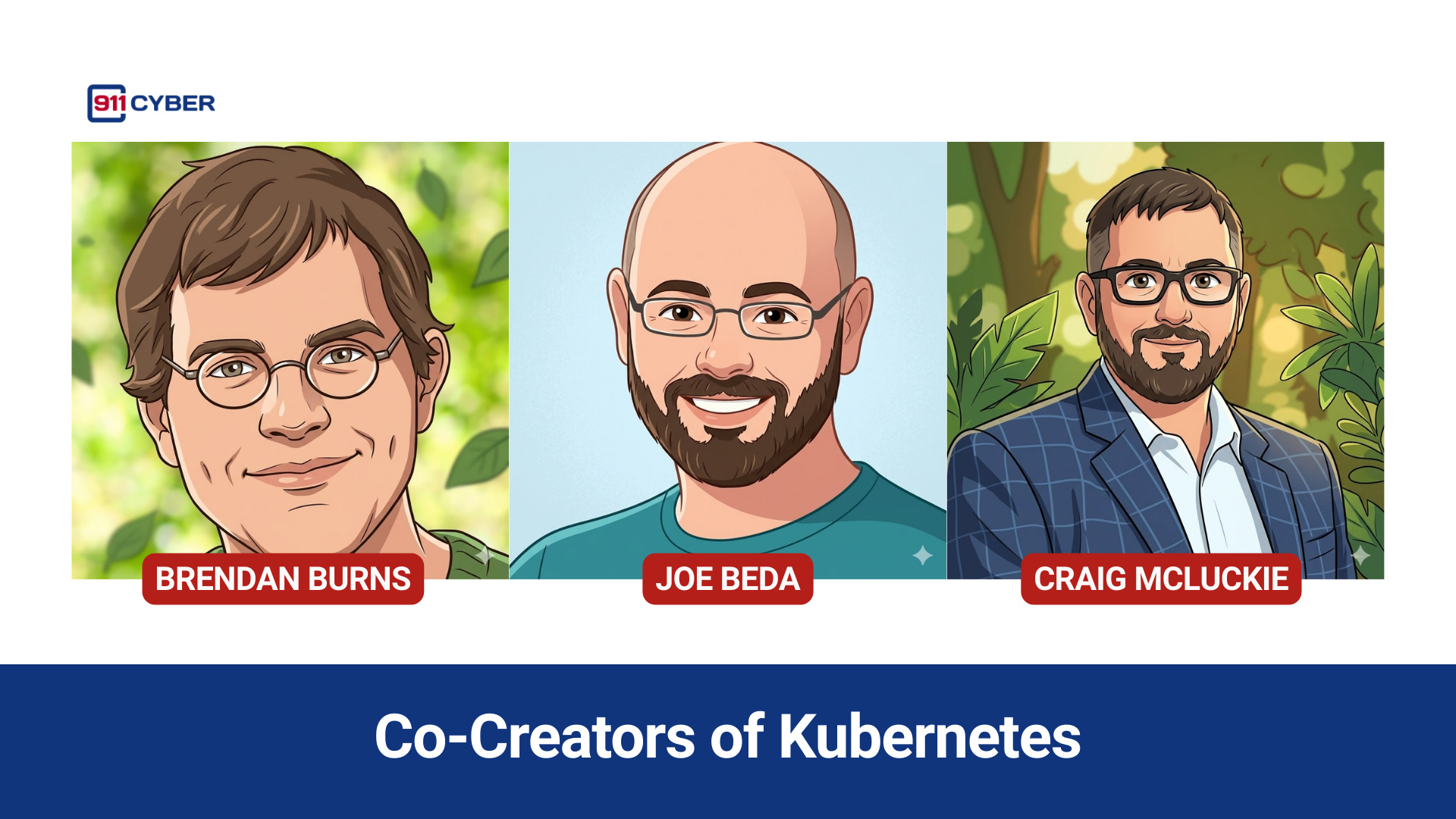
Kubernetes is an open-source container orchestration platform created in 2014 by Joe Beda, Brendan Burns, and Craig McLuckie at Google. It was inspired by Google’s internal systems Borg and Omega and designed to automate the deployment, scaling, and management of containerized applications across clusters of machines.
The project emerged as containers replaced traditional virtual machines for application packaging. Containers virtualize the operating system rather than underlying hardware, making them lightweight and portable. Kubernetes was built to orchestrate these containers at scale, assembling multiple machines into a unified cluster that operates as a single logical compute platform.
At its core, Kubernetes follows a declarative model. Users define the desired state of applications in YAML manifests, and the control plane continuously reconciles the actual state to match that intent. The control plane consists of the API server, scheduler, controller manager, and etcd, which stores cluster state via the Raft consensus algorithm. Worker nodes run the kubelet, a container runtime such as containerd or CRI-O, and kube-proxy to manage networking. Core primitives such as Pods, Services, Namespaces, Volumes, and Labels provide workload grouping, service discovery, persistence, and multi-tenancy.
Kubernetes was open sourced in mid-2014 and donated to the Linux Foundation in July 2015, leading to the creation of the Cloud Native Computing Foundation as its neutral home. It graduated as the CNCF’s first project in 2018 and maintains a regular release cadence of approximately three minor releases per year. Governance is managed through the CNCF with a structured Special Interest Group model and broad multi-vendor participation.
Today, Kubernetes runs on public cloud managed services such as GKE, EKS, and AKS, as well as in on-premises and edge distributions including K3s and MicroK8s. It underpins microservices architectures, internal developer platforms, AI and ML workloads, and large-scale SaaS environments across enterprises worldwide.
Subscribe and Comment.
Copyright © 2026 911Cyber. All Rights Reserved.
Follow 911Cyber on: