


Every day, we generate a vast trail of digital data through our phones, apps, searches, and online interactions. Because much of this happens quietly in the background, many people assume it doesn’t matter. That’s why a common response to privacy concerns is: “I have nothing to hide.”
But this idea misunderstands how the digital world works. Privacy isn’t about hiding wrongdoing. It’s about preventing your personal information from being collected, analyzed, and used in ways you never intended. Even the most ordinary information can become powerful in the wrong hands.
🔍 What do I have to hide?
A better question is: “Do I have anything someone else could weaponize?”
Your seemingly innocent data, your location history, browsing habits, political views, private photos, and financial behavior, are not crimes.
However, in the hands of cybercriminals, data brokers, or malicious actors, these details become tools for manipulation, fraud, coercion, or surveillance.
This is the central reason why personal data is now one of the world’s most valuable commodities.
📊 The “Nothing to Hide” Data Map
To a cyber-attacker, you aren’t a person; you are a multi-dimensional data set.
When you say you have “nothing to hide,” you’re assuming they want your deep dark secrets. They don’t.
They want the “mundane” data points that allow them to impersonate you, predict your behavior, and bypass your security.
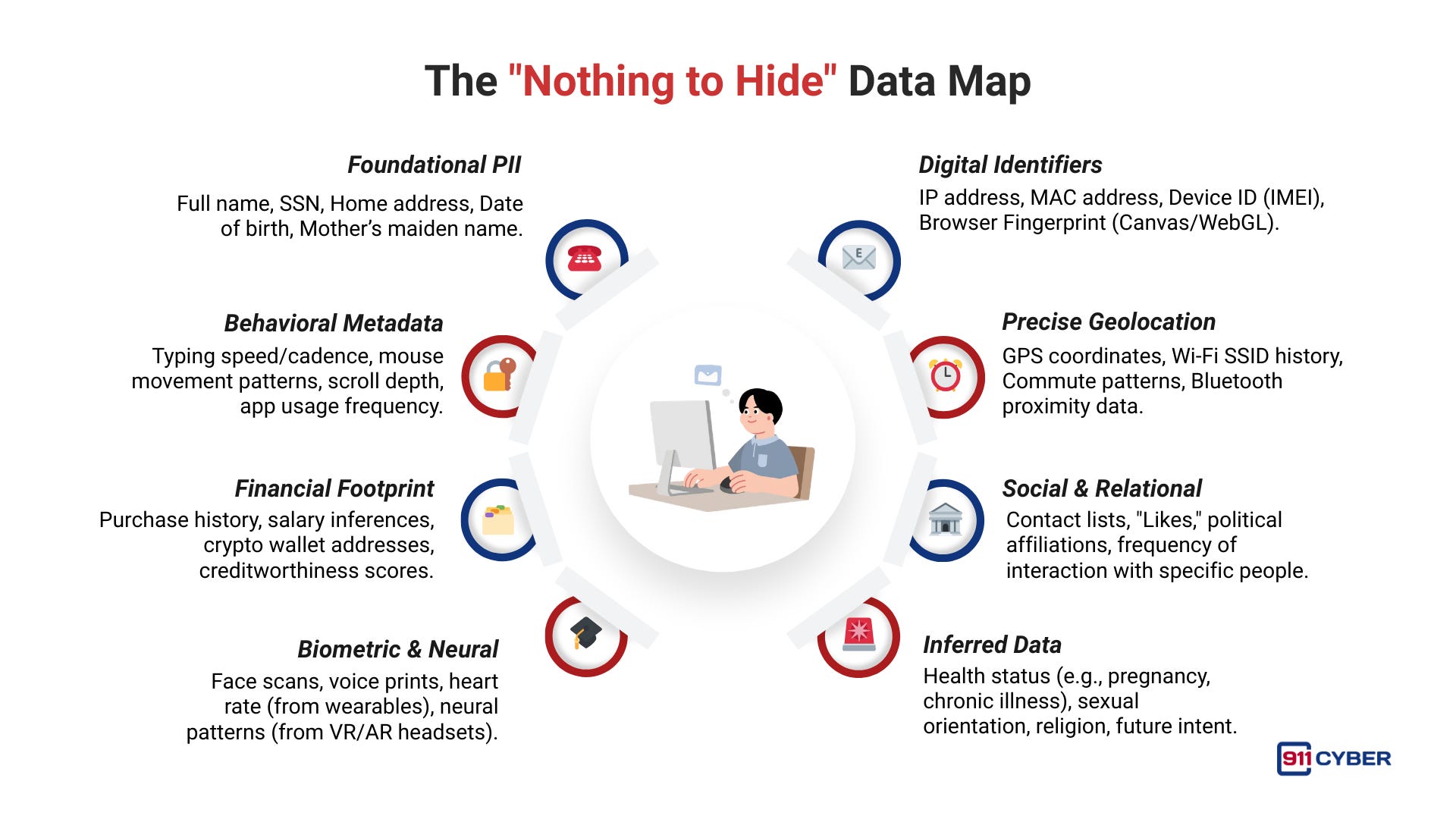
Many of these data points are never explicitly given by you. They are inferred by algorithms.
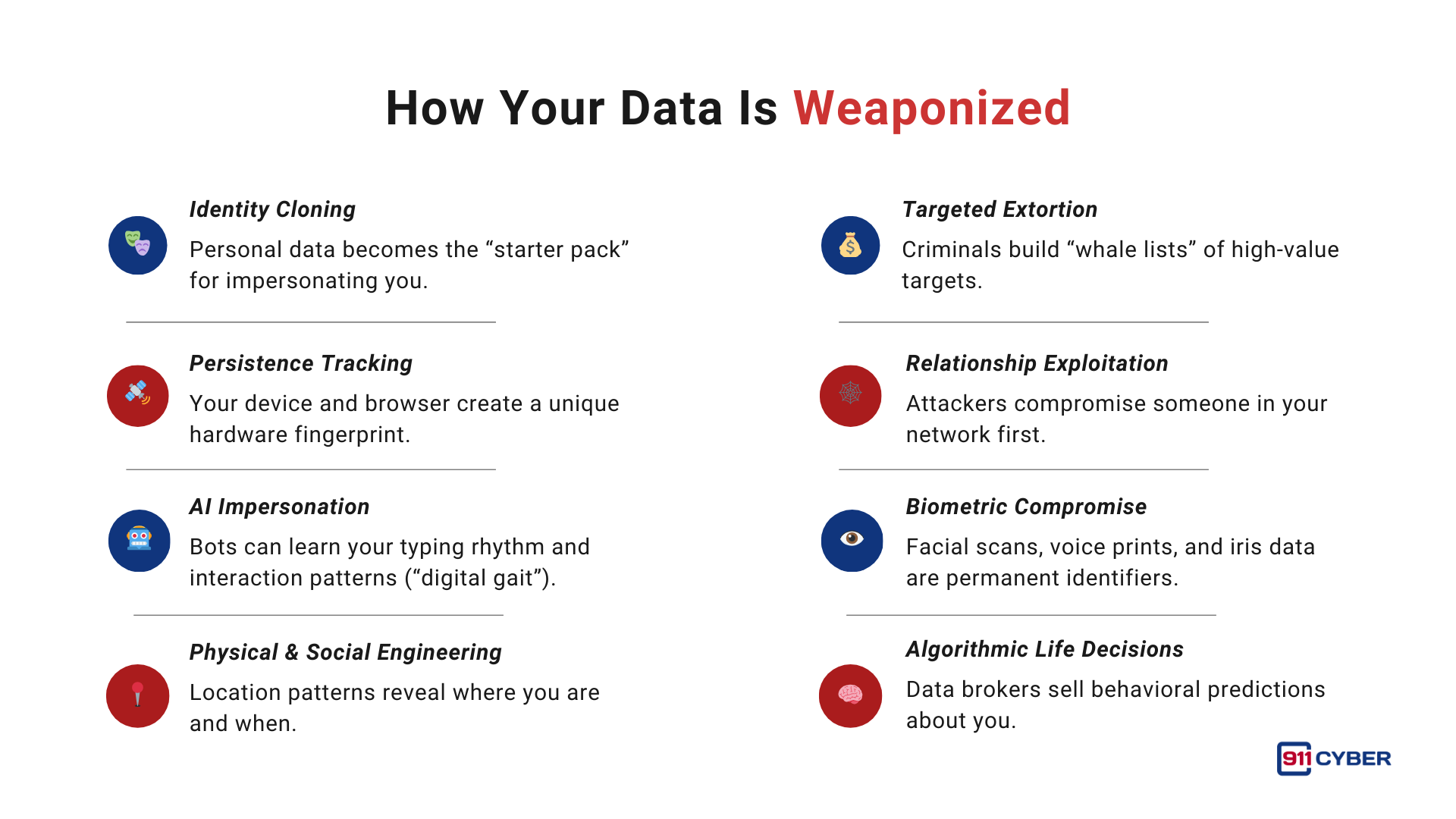
📌 How Your Data Is Weaponized
Cybercriminals and malicious actors are not looking for deep secrets. They are looking for the mundane data points that allow them to impersonate you and bypass security. They care if they can use your data to weaponize your information.
You may be denied: a loan, a job, insurance coverage based on an AI prediction about your future health or behavior.
🧠 Privacy Is Power and Control
When large organizations collect vast amounts of personal data, they gain a massive asymmetry of power over the individual. This imbalance is a central threat to digital autonomy.
Their data advantage allows them to:
Predict your behavior.
Influence your decisions and opinions.
Adjust prices for products and services dynamically.
Shape the content and news you see.
Construct detailed profiles of your life (health, politics, finances).
Privacy is often misunderstood as secrecy. It is not.
Privacy is about control.
It is the right to decide who can access, analyze, and profit from your digital life.
Without that control, data becomes a tool for manipulation, exploitation, and behavioral influence.
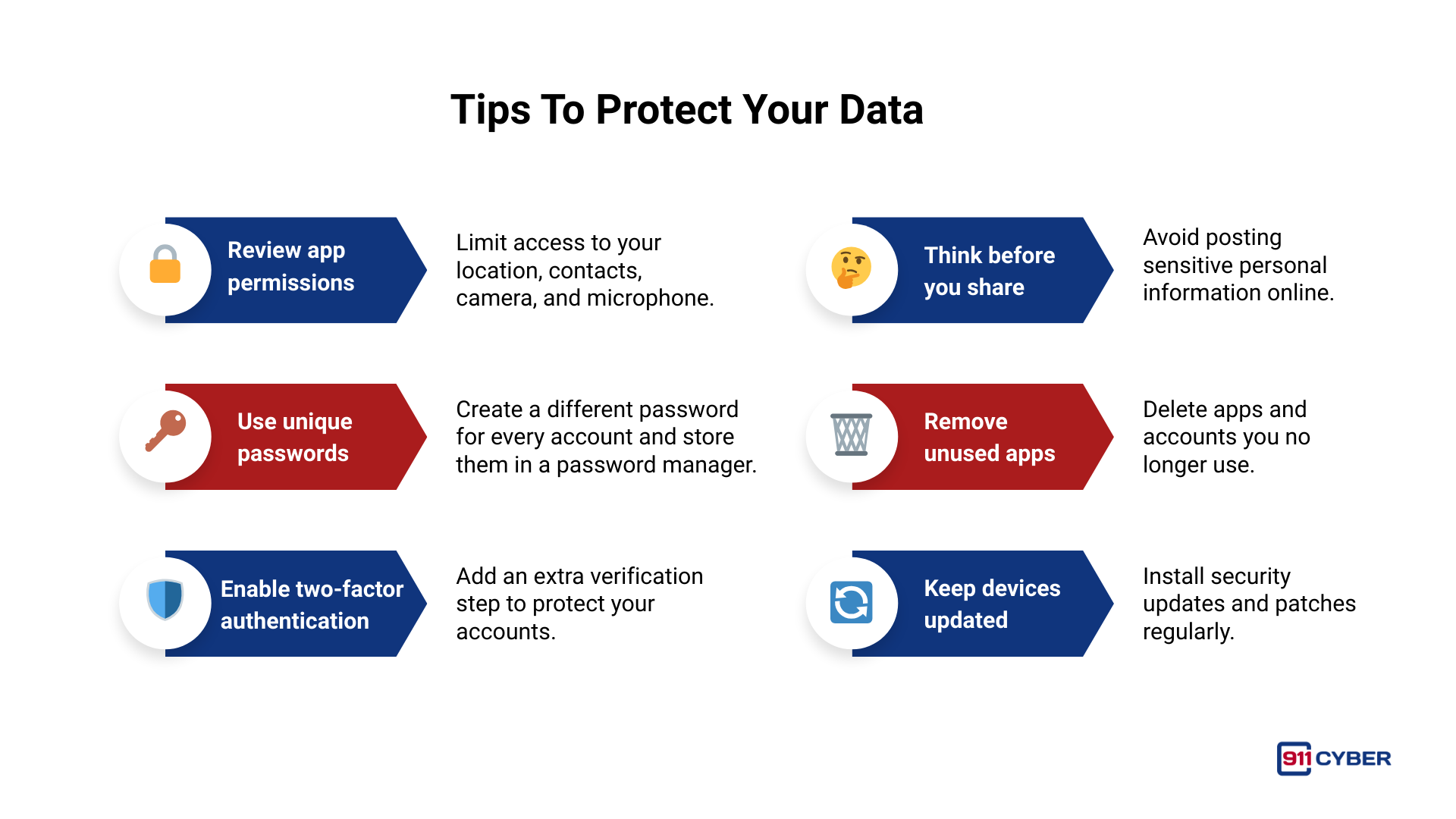
🛡️ How to Protect Yourself
You do not need to disappear from the internet.
But you should reduce unnecessary exposure.
Small habits can dramatically improve your digital security.
🧰 What Resources Are Available to Help?
📚Books
DIGITAL FOOTPRINT DEFENSE by Eduardo Maschietto
Protecting Your Digital Footprint by Nicholas Lucia
Protecting Your Digital Footprint by Isaac Hungbeme
Unsearchable by William Crawford
Your Digital Privacy Playbook by Gabe Herrera
Declutter & Defend by Alessio rocchI
🎙️ Podcasts
How to Protect Yourself (and Your Data) Online with Sarah Childress, Julia Angwin and Hanni Fakhoury
Data Protection Made Easy with Caine Glancy and Catarina Pereira dos Santos
Your Technology Is Tracking You. Take These Steps For Better Online Privacy with Laurel Wamsey and Eva Galperin
▶️ Videos
🛠️ Tools
Tor Browser - Free and open-source anonymity browser.
KeePass / KeePassXC - Fully free open-source password managers.
Signal - Free open-source encrypted messaging app.
Outline VPN - Free open-source tool to deploy a private VPN server.
🔒 Final Thoughts
The phrase “I have nothing to hide” assumes that privacy is about guilt. It isn’t.
Privacy is about control.
Control over who can access your information.
Control over how your data is interpreted.
Control over how it can be used, or misused, against you.
The real question isn’t whether you have something to hide.
The question is: Could someone use your data against you?
In the modern digital economy, data is power.
Protecting your privacy isn’t paranoia. It’s protecting your autonomy in a world where information can easily be turned into influence, manipulation, or exploitation.

Subscribe and Comment.
Copyright © 2026 @ 911Cyber All Rights Reserved.
This article was written by Marc Raphael with the support of:
Team CyberMaterial and Team 911Cyber
Follow 911Cyber on: https://linktr.ee/911cyber