



Online betting has become one of the fastest-growing digital industries on the planet and one of the most fertile hunting grounds for cybercriminals. Every thirty seconds, someone loses money to an online betting scam. In 2024 alone, losses surpassed $4.3 billion. This week, CyberHygiene goes all in on the fraud hiding inside your sportsbook.

🎰 What Is Online Betting, and How Does It Work?
Online betting is the act of placing wagers on sporting events, casino games, poker, or other outcomes through internet-based platforms and mobile apps. It is a broad category that includes sports betting (NFL, NBA, football, horse racing), iGaming (virtual slots, blackjack, roulette, poker), fantasy sports, and increasingly, esports.
The mechanics are straightforward: a user creates an account on a licensed platform, deposits funds via credit card, bank transfer, or cryptocurrency, then places bets on outcomes. Platforms set odds, calculated probabilities that determine how much a winning bet pays out. If your prediction is right, your winnings are credited to your account and can be withdrawn. If wrong, the stake is lost.
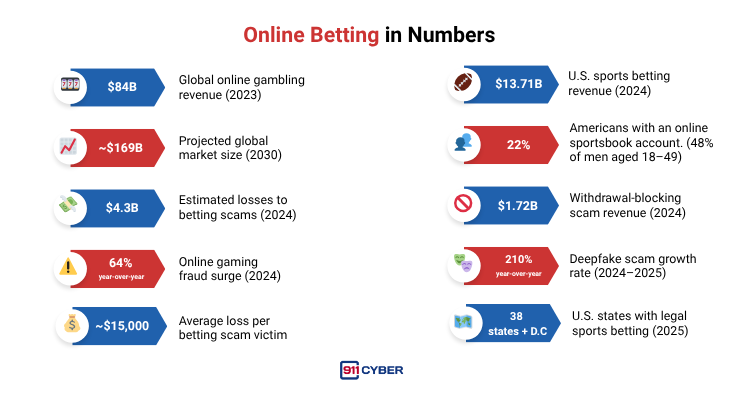
The 2018 U.S. Supreme Court ruling striking down federal restrictions on sports betting opened a tidal wave of legalization. Today, 38 U.S. states allow some form of legal sports betting. In 2024, Americans legally wagered $13.71 billion, up from $4.29 billion in 2021. Global online gambling revenues topped $84 billion in 2023 and are on a trajectory toward $169 billion by 2030.
Where there is money, there is fraud. And with millions of new, inexperienced users entering the betting ecosystem every year, many of them unfamiliar with the red flags, the conditions for scams couldn’t be more perfect.
🕵️♂️ Threats: The Scammer's Full Playbook
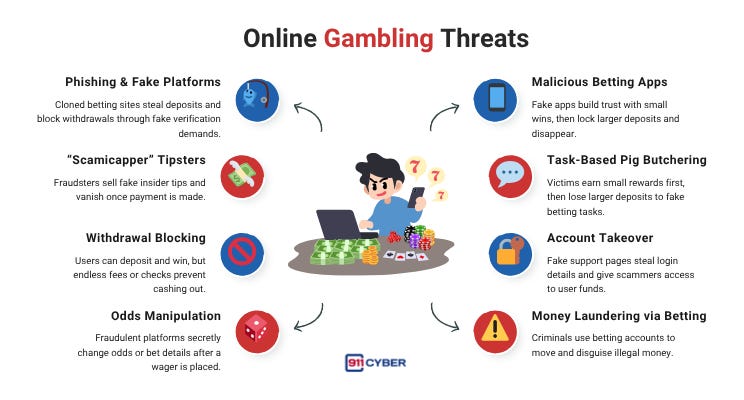
Betting fraudsters don't operate on instinct. They run sophisticated enterprises with designers, developers, and customer service teams. Here are the main attack vectors:
📈 How Big Is the Problem?
The scale of online betting fraud is staggering and almost certainly undercounted. According to FBI data, only an estimated 13% of betting scam victims ever report the crime. Most blame themselves for bad luck, for poor strategy, never realizing they were robbed.
The Better Business Bureau received nearly 200 scam reports and over 10,000 business complaints related to online gambling and gaming between 2022 and mid-2025. The average victim loses approximately $15,000 though high-value targets have lost six figures. Forty-five percent of victims report suffering from anxiety, depression, or suicidal thoughts in the aftermath.
“Many victims don’t realize they’ve been defrauded they blame losses on bad luck or poor betting strategy. The ‘dark figure’ of fraud that remains officially uncounted is massive.”
The most vulnerable are new players still learning the platforms, people with gambling addictions, those experiencing financial stress, and increasingly older adults. A 2024 survey found that 18% of people over 65 participate in online sports betting “very often.” Younger users are targeted through social media ads. In short: there is no safe demographic.
📊 Online Betting in Numbers
🤖 How AI Is Reshaping the Threat Landscape
AI has amplified scammers’ capabilities, allowing one person to execute what previously required a team.
AI as the Scammer’s Superpower:
AI generates convincing voice and face deepfakes for hundreds of multilingual, fake gambling ads.
Fake app store reviews are created rapidly in any language to legitimize malicious apps.
Stolen data feeds AI models that craft highly personalized, effective phishing messages.
AI clones voices in real-time for fraudulent “customer support” to reassure victims and delay chargebacks.
Deepfake financial scams surged 210% between 2024 and 2025, prompting alerts from the FBI, FinCEN, and NY DFS. The EU AI Act (mid-2025) targets identity manipulation, though cross-border enforcement is challenging.
🛡️ Protect Yourself: Your Personal Playbook
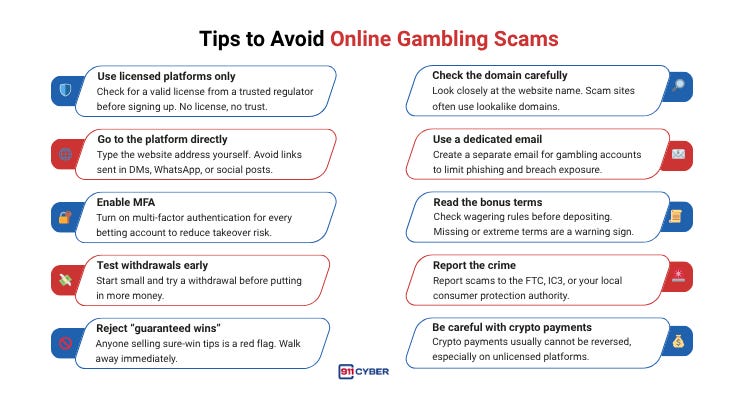
You cannot control the industry. You can control your behavior. Here is what every bettor should do:
🧰 What Resources Are Available to Help?
📚Books
Smart betting secret and scam expose by OG FSO
Wired for Risk: The Rise of Online Gambling Addiction by Adam LeMoine
Gambling on AI by James Whittaker Screech
🎙️ Podcasts
Online Gambling Scams by Office of Justice Affairs
The Gambling Files by Jon Buford and Fintan Costello
Online Gambling Fraud Exposed on Corefy with Mike Ferrier MBE
▶️ Videos
Scammers Are Getting Smarter: Gaming Payments & Fraud Prevention on MaxBet Podcast with Diallo Gordon, Mike McKiski and Hillary McAfee
🛠️ Tools
uBlock Origin: for blocking malicious betting ads and scam popups.
KeePassXC: for creating and storing unique passwords for betting and financial accounts.
dnstwist: for checking lookalike betting domains and fake clone sites.
FTC ReportFraud: for reporting online betting or gambling scams.
FBI IC3: for filing complaints about internet-enabled betting fraud.
BBB Scam Tracker: for reporting scams and checking whether others saw the same fraud.
NCSC scam reporting: for reporting suspicious scam websites and phishing in the UK.
UK Gambling Commission Public Register: for checking whether a gambling operator is officially licensed.
Malta Gaming Authority Register: for verifying whether an online betting site holds an MGA license.
💰 The Bottom Line
Online betting isn’t going away. The industry will reach $169 billion by 2030, and more people than ever are placing wagers from their phones. That scale creates an enormous opportunity for legitimate operators and for criminals alike.
The scammers will keep finding new vectors. AI gives them tools that scale faster than any human enforcement operation can respond. But knowledge remains the most effective defense. Understanding how the fraud works, the fake apps, the withdrawal blocks, the Telegram tipsters, the deepfake ads, makes you vastly harder to victimize.
The house always has an edge. The scammer’s edge is your trust. Withdraw it before they do.
Stay safe. Stay skeptical. And if something feels too good to be true in the world of online betting, it is, every single time.

Subscribe and Comment.
Copyright © 2026 @ 911Cyber All Rights Reserved.
This article was written by Marc Raphael with the support of:
Team CyberMaterial and Team 911Cyber
Follow 911Cyber on: https://linktr.ee/911cyber