


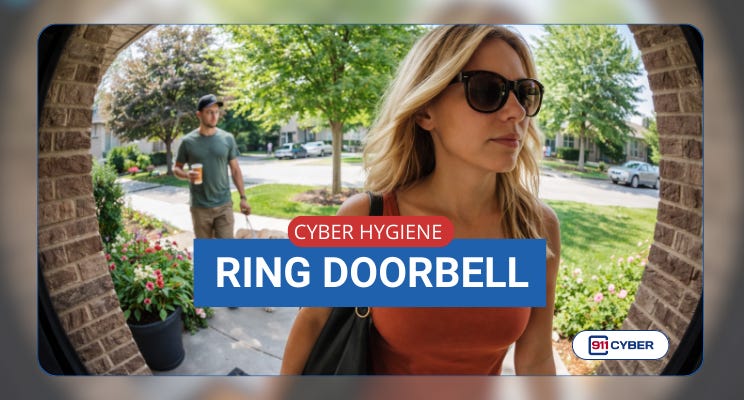
Welcome to Cyber Hygiene, my weekly newsletter, where I share tips and actionable data to help everyone stay safe online.
📷 What Is a Ring Camera?
Ring is a consumer home security company owned by Amazon . Its products include video doorbells and security cameras designed to monitor doors, yards, and indoor spaces.
These devices record video, detect motion, send alerts to users’ phones, and store footage in the cloud. Ring also operates the Neighbors app, which allows users to share videos and alerts with people nearby and, in some cases, local authorities.
Marketed as safety tools, Ring cameras function as always-on sensors connected to cloud infrastructure and increasingly powered by AI.
🔍 What Are the Privacy Concerns?
Ring’s privacy issues are not hypothetical. They are documented.
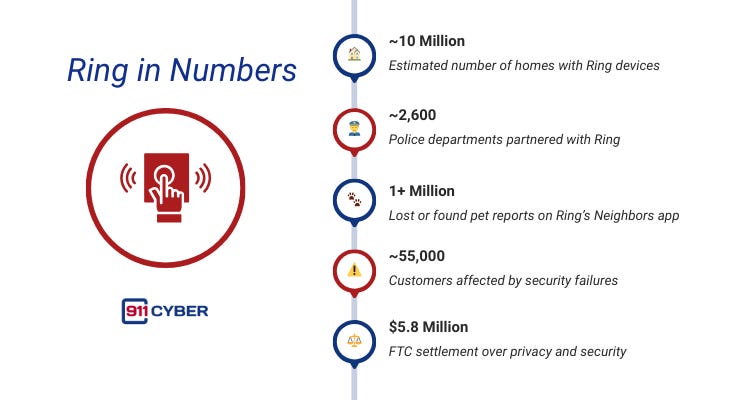
In 2023, the U.S. Federal Trade Commission found that Ring employees had unrestricted access to customer video feeds for years, allowing them to view private footage without sufficient oversight. In addition, weak security practices enabled hackers to take over accounts and spy on users.
Ring has also faced criticism for encouraging widespread video sharing with law enforcement, sometimes without warrants, and for capturing footage of people who never consented to being recorded.
When cameras are installed on private homes but monitor public and semi-public spaces, privacy stops being an individual choice.
🤖 How Do New AI Features Impact Privacy?
Recent and recent-adjacent features, including facial recognition, tagging familiar faces, and AI-powered search across video footage, shift Ring from passive recording to active identification.
Even when users only label people they know, the system still scans every face that appears on camera. That means neighbors, delivery workers, visitors, and passersby are analyzed without consent.
This is a fundamental shift. The technology is no longer just recording events. It is interpreting human presence.
📊 Ring in Numbers
🔐 What Are the Security Concerns?
Internet-connected cameras are high-value targets.
Ring has experienced multiple security incidents, including account takeovers where attackers accessed live feeds, spoke through cameras, and monitored households. These incidents were enabled by poor authentication controls and delayed enforcement of security best practices like mandatory two-factor authentication.
When a security camera is compromised, it does not just expose data. It exposes real people, real homes, and real routines.
🌍 How Can This Impact Everyone?
You do not need to own a Ring camera to be affected by one.
A single doorbell can record an entire sidewalk. Multiple cameras can map daily routines. AI features can quietly turn neighborhoods into sensor networks.
As more people adopt these devices, opting out becomes impossible. Privacy erosion becomes collective, not individual.
⚠️ How Privacy Failures Can Reduce Safety
Surveillance does not automatically equal safety.
Footage leaks can expose victims, witnesses, and vulnerable individuals. Abusers can misuse cameras for stalking. Criminals can analyze publicly shared videos to plan attacks.
When trust in technology erodes, people change their behavior, avoid public spaces, and hesitate to seek help.
Safety without privacy is fragile.
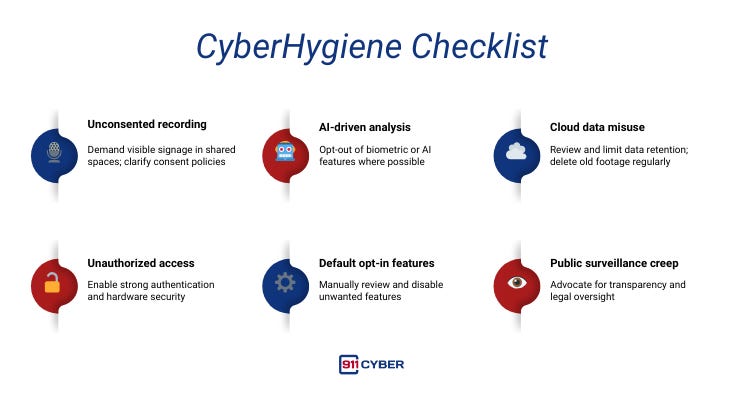
🧰 CyberHygiene Checklist
🏙️ What can you do about cameras and AI in public places?
Awareness is step one.
Support transparency laws, local regulations, and community discussions around surveillance technology. Ask schools, apartment buildings, and workplaces how cameras are used, stored, and protected.
Push for clear boundaries. AI should assist humans, not silently monitor them.
🧠 Why Nobody Is Exempt
It is easy to think privacy risks only apply to people who own smart cameras. That assumption is wrong.
You can be recorded without ever installing a device. A neighbor’s doorbell can capture your face. A delivery camera can log your routines. A shared hallway camera can store your movements in the cloud. Once AI is added, those recordings are no longer passive. They become searchable, sortable, and analyzable.
You do not need to opt in to be included. You simply need to walk by.
Children, visitors, delivery workers, and vulnerable populations are especially exposed. They have no control over how long footage is stored, who accesses it, or how it is used in the future. Even if a system is marketed as private, the people being recorded rarely have visibility or consent.
As surveillance technology spreads, opting out becomes impossible. Privacy stops being a personal setting and becomes a community issue. That is why CyberHygiene is no longer just about protecting your own devices. It is about understanding how other people’s devices affect you too.
🧰 What Resources Are Available to Help?
📚Books
AI in the Surveillance: The Digital Eye of Control by Sebestyén István
The Age of Surveillance Capitalism by Shoshana Zuboff
American Surveillance: Intelligence, Privacy, and the Fourth Amendment by Anthony Gregory
Mastering AI Home Security Camera by Vector Sentry
Video Surveillance: Power and Privacy in Everyday Life by Bilge Yesil
🎙️ Podcasts
Is Your Ring Doorbell Feeding ICE? The Surveillance Trade You Never Agreed To on Rethinking Tech by Aparna Bhushan and Dr. Harinda K.
Ring Doorbells Just Got Facial Recognition — Why Privacy Experts Are Worried! On Shared Security Podcast hosted by Tom Eston and Scott Wright
Amazon Privacy & Spotify Fines on the The Data Rockstar’s Coffee PodCAST
▶️ Videos
Shoshana Zuboff on surveillance capitalism | VPRO Documentary by VPRO
🔑 Final Thoughts
Ring’s AI camera is marketed as a symbol of safety, community, and peace of mind. The Super Bowl commercial frames a growing surveillance network as a tool for good, helping neighbors find lost dogs and feel more connected.
But technology rarely stays confined to its original purpose. What begins as a convenience feature often evolves into a broader system of monitoring, data collection, and automated decision-making. When AI quietly analyzes faces, movements, and behaviors across millions of front doors, privacy is redefined without a clear public conversation.
The real risk is not a single feature or a single company. It is how quickly surveillance becomes normal, invisible, and unquestioned. When privacy fades, trust erodes. When trust erodes, safety becomes fragile.
CyberHygiene is about awareness before acceptance. The future of privacy will not be decided by ads or algorithms alone. It will be shaped by how willing we are to question what we invite into our homes and neighborhoods.
https://www.sec.gov/Archives/edgar/data/1018724/000121465924009029/o514240px14a6g.htm

Subscribe and Comment.
Copyright © 2026 @ 911Cyber All Rights Reserved.
This article was written by Marc Raphael with the support of:
Team CyberMaterial and Team 911Cyber
Follow 911Cyber on: