


We often focus on the price of a stolen record or the final ransom demand.
But in 2026, the most dangerous cost is not a line item. It is the silence that follows 10,000 alarms.
Modern cybersecurity has reached a structural breaking point. More data no longer equals better security. It has created a systemic crisis known as alert fatigue. When defenders are buried under digital noise, they do not just get tired. They disengage.
And when attention collapses, risk compounds.
The Problem at a Glance
Security Operations Centers are flooded with alerts. Most are not actionable. These alerts originate from EDR, SIEM, cloud monitoring platforms, firewalls, identity systems, and behavioral analytics tools.
Instead of clarity, they produce volume that exceeds human cognitive limits.
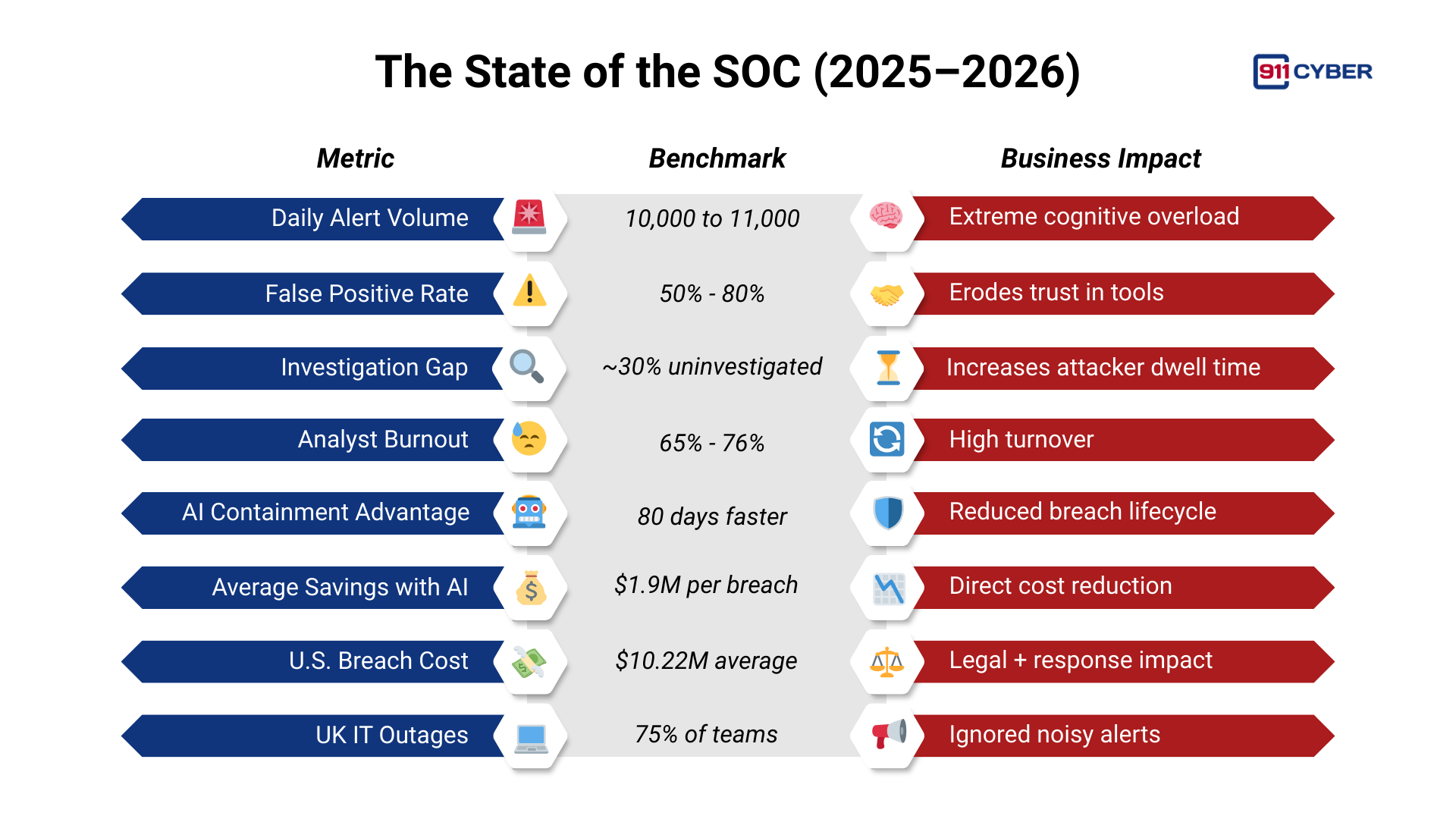
Enterprise SOCs now process between 10,000 and 11,000 alerts per day.
False positive rates range from 50% to 80%.
Approximately 30% of alerts are never investigated.
At that scale, no analyst can meaningfully assess everything.
Critical signals disappear inside statistical noise.
Why This Matters
Alert fatigue is not an annoyance. It is a measurable operational risk.
When alerts go un-reviewed:
Threat dwell time increases
Mean Time to Detect expands
Mean Time to Contain slows
Breach impact escalates
According to the 2025 Cost of a Data Breach report by IBM:
Global average breach cost: $4.44 million
U.S. average breach cost: $10.22 million
Average time to identify a breach: 181 days
Total breach lifecycle: 241 days
Organizations extensively using AI and automation reduced breach costs by $1.9 million and shortened containment by 80 days.
Noise does not stay operational. It becomes financial.
The Human Cost
Cybersecurity fatigue is now a workforce crisis.
47% of risk and security professionals report burnout
10% describe their condition as severe or near exit
70% of junior analysts leave within three years
Burnout reduces productivity by 39% and engagement by 33%
The World Economic Forum reports that two out of three organizations face moderate to critical cybersecurity talent shortages.
Replacing a SOC analyst costs between $75,000 and $150,000 when factoring recruitment, on-boarding, and productivity loss.
Burnout is not only a morale issue. It is capital erosion.
The Hidden Economics of the SOC
A 24/7 internal SOC requires:
$1M to $2M in infrastructure investment
$1.5M or more annually in staffing
Tier 1 analyst salaries between $80,000 and $120,000
Recruiting premiums of 20% to 30% of first-year salary
Yet 90% of SOC teams report being overwhelmed by backlogs.
The architecture scales alert generation faster than it scales human cognition.
The constraint is no longer tooling. It is attention.
The Psychology of the Vicious Loop
Alert fatigue is a neurological adaptation.
When analysts receive relentless notifications, the brain shifts from analytical processing to reactive filtering.
In 2025, 73% of organizations identified false positives as their primary detection obstacle.
The cycle looks like this:
Over-stimulation
Massive volumes of unfiltered alerts overwhelm cognitive capacity.Desensitization
Repeated low-value alerts reduce perceived urgency.The Gap
Legitimate threat signals blend into background noise.The Risk
Up to 30% of alerts remain uninvestigated, providing attackers operational cover.
This is not laziness. It is cognitive overload.
The ROI of Human Resilience
The economics are clear.
We cannot hire our way out of a telemetry explosion.
A manual SOC model now costs between $1M and $4M annually, yet most teams remain overwhelmed.
The shift in 2026 is toward agentic AI. Systems that do not merely trigger alerts but investigate them.
Automating Tier 1 triage can process up to 90% of repetitive cases.
Time to contain can shrink from roughly 40 minutes to under 3 minutes in mature environments.
The objective is not cost cutting.
It is cognitive preservation.
Organizations that implement risk-based prioritization see burnout drop from 63% to 44%.
When analysts focus on adversary behavior instead of noise dismissal, resilience increases across the enterprise.
The Bottom Line
In 2026, the most expensive alert is the one your team was too exhausted to notice.
Alert fatigue is not a side effect of modern cybersecurity.
It is the central operational risk inside it.
Sources:
https://www.sans.org/mlp/detection-response-survey/
https://www.ibm.com/reports/data-breach
https://www.weforum.org/reports/global-cybersecurity-outlook-2025
Subscribe and Comment.
Copyright © 2026 @ 911Cyber All Rights Reserved.
This article was written by Marc Raphael with the support of:
Team CyberMaterial and Team 911Cyber
Follow 911Cyber on: https://linktr.ee/911cyber