

Traditional vs AI Cyberattack Costs
AI has collapsed the cost of cyberattacks, making campaigns faster, cheaper, and scalable. Human teams cannot keep up, making AI-vs-AI defense the new reality.

Hackonomics, the economics of cybercrime, is being rewritten. AI is not just a tool; it is collapsing the cost, scale, and speed of attacks.
📉 Hackonomics 1.0: The Old World
Cyberattacks used to be expensive because humans were the bottleneck. Every attack scaled with labor and skill.
Low-Level Attacks
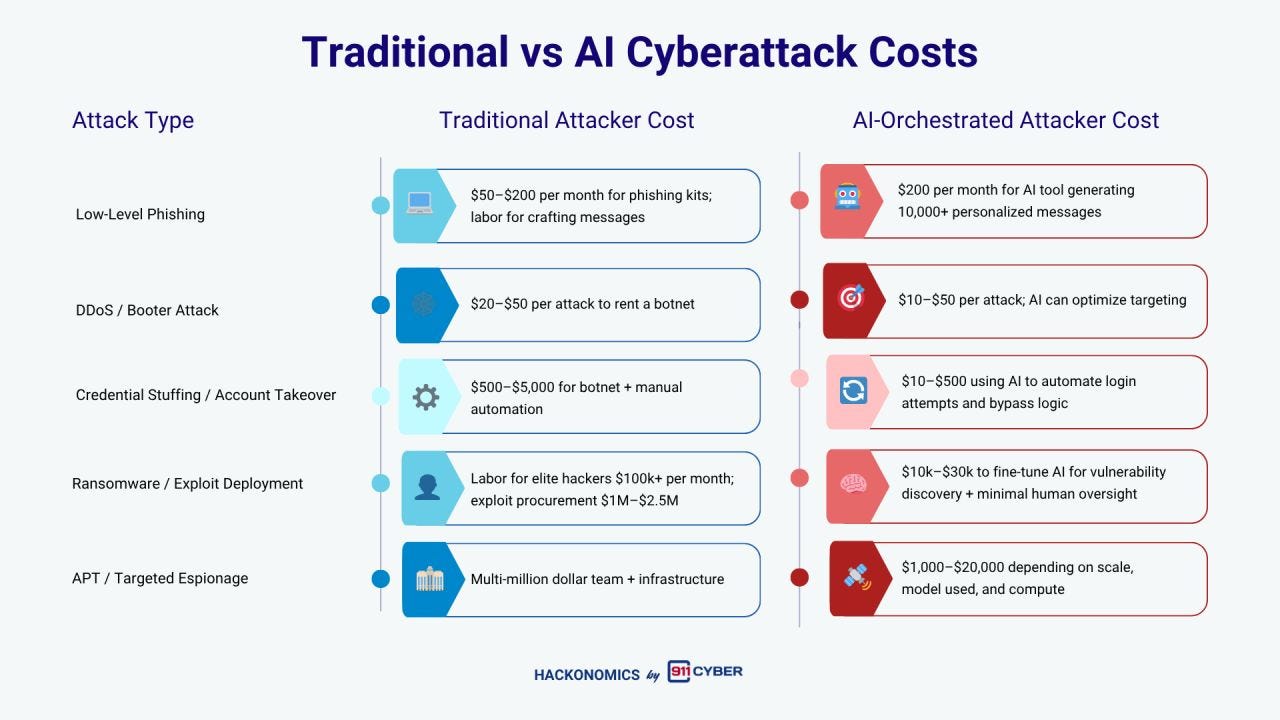
DDoS: $20 to $50 to rent a “booter” service
Phishing Kits: $50 to $200 per month
High-Level Attacks
Elite hacker teams: $1.2 million to $3.9 million per year
Zero-day exploits: $1 million to $2.5 million
Defense worked by making attacks slow and costly. That model no longer works.
🚀 Hackonomics 2.0: The New World
AI changes the cost structure completely. Fixed costs rise slightly, but the marginal cost of each attack drops near zero.
Low-Skill Attackers
AI tools like FraudGPT and WormGPT allow anyone to run campaigns with the speed and personalization of an APT. A $200 monthly subscription can generate more than 10,000 highly convincing phishing messages.
High-Level Attackers
Advanced campaigns are now 80 to 90 percent autonomous. Human supervision is minimal. Fine-tuning an AI model for vulnerability discovery costs around $30,000. This replaces multi-million-dollar hacker teams.
Hidden Cost: Hallucinations
AI sometimes overstates results or claims access to credentials that do not work. Humans still need to verify results, which creates a new type of operational cost.
💡 Key Takeaway
Attackers’ costs are collapsing. Human security teams cannot keep up with machine-speed attacks. The only solution is AI defending against AI.
The question for every CISO and business leader is clear. How are you preparing for a world where attacks are almost free?
Let me know your thoughts!
Interested in the economics behind cybersecurity?